

You want to lose weight. You may also be worried about your blood sugar. You have tried making changes, but they never seem to last.
So you start searching.
“Can I eat brown rice?”
“What about oatmeal, bread, or fruit?”
“Is a ‘sugar-free’ snack a better choice?”
“How much should I eat?”
“How much exercise is enough?”
Soon, the rules pile up. You try to ignore your hunger, choose foods that sound healthy, and search again whenever you feel unsure.
But you may still know very little about how your own body responds.
I know that feeling. I tried weight-loss supplements, herbal remedies, eating less, and a low-carb, high-fat diet. I lost 10 kg—about 22 pounds.
Then I learned something important: losing weight and knowing how to care for my body were two different things.

I Started with Questions About My Own Body
I’m Juyoun Park, the person behind DiaLife. I have studied and researched the immune system. I’m not a doctor.
My health checks showed prediabetes and problems with my blood fat levels. I wanted to understand what was happening and what I could do in daily life.
Why was keeping weight off so hard? Why could the same meal lead to different blood sugar readings? Was one lower reading enough to tell me things were going well?
I studied, tried things, and paid attention. Over time, I changed how I looked at my body and the choices I made each day.
From “Can I Eat This?” to “How Can I Make This Work?”
“Can I eat bread?” is a fair question.
As you learn more, I hope you can also ask:
“How much makes sense for me?”
“What could I eat with it?”
“What have I noticed when I eat this?”
“How does it fit with the rest of my day?”
These questions help you think about your needs, the foods you enjoy, and any advice from your healthcare team.
My hope is that choosing a meal gets easier. You can keep asking for help while learning to make more choices for yourself.
Look at Your Day Before Changing Everything
Start with what you already do.
You might notice:
- What you eat and when.
- When you feel hungry and how you feel after eating.
- How your digestion and bowel habits have been.
- How well you sleep.
- When you move and when you sit for a long time.
- Your blood sugar readings, if checking them is already part of your care.
You do not need to track everything. Pick a few things that help you understand your day.
For example, a note might say:
“I ate lunch in a rush. I was hungry again later. I also slept badly last night.”
That note does not tell you what caused the hunger. It helps you remember what was happening.
After a few notes, you may start asking better questions. Does this happen often? What is different on the days when I feel better?
Start by getting to know the habits you already have.
Blood Sugar Is One Part of the Picture
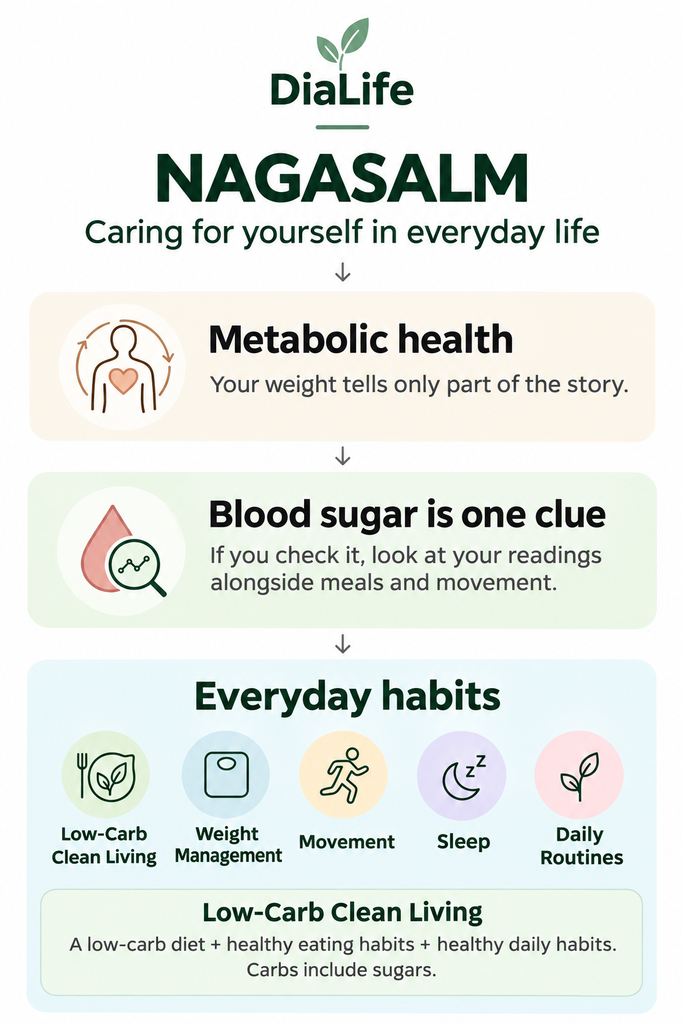
I use blood sugar readings as one way to learn about my body.
I look at what I ate, how much I ate, when I checked, and what else happened that day. A number makes more sense when I can see the day around it.
At first, I used a finger-prick meter. It showed me my blood sugar at the moment I checked. Later, I wanted to know what happened between those checks.
That led me to a continuous glucose monitor, or CGM. A CGM uses a small sensor to estimate glucose levels throughout the day and night. It can help show how those levels change over time.
Some people need ongoing use as part of their diabetes care. Others may use one for a short time with guidance from their healthcare team. [1]
You can start paying attention to your meals and habits without buying a device. If you already check your blood sugar, follow the timing and targets your healthcare team has set with you.
For me, the purpose is to understand more about my body. A reading is a piece of information, not a score for how well I ate.
The Approach I Developed: Low-Carb Clean Living
As I worked on my weight and blood sugar, I kept coming back to the same daily choices: what I ate, how much I ate, how I moved, and how I rested.
Over eight years of managing my weight and prediabetes, I developed an approach I call Low-Carb Clean Living, or 저탄건식 in Korean.
The Korean name brings together three ideas:
A low-carbohydrate diet, healthy eating habits, and healthy lifestyle habits.
Carbohydrates include sugars.
This approach brings together what I have studied, practiced, and learned from my own life. My experience with a low-carb, high-fat diet was part of that process. So were the problems that led me to decide I could not keep eating that way over the long term.
I needed habits I could live with through busy days, family meals, travel, and changes in life.
Low-Carb Clean Living grew from that need. It connects food choices with the way I eat and live each day.
Know How to Return to Your Routine
I eat out. I travel. Sometimes I eat more than I planned.
I rarely use the phrase “cheat day.” I want to enjoy food without treating a meal as something I did wrong.
What matters to me is knowing how to return to my usual habits. I prepare the next meal and carry on. I do not need to turn one evening into a judgment about the whole week.
Being able to return is part of caring for yourself.
A routine needs room for real life. The more I practice coming back to it, the easier it becomes to keep going.
Start with One Meal Today
Choose one meal today. Write down when you ate, what you ate, and how you felt afterward.
A few words on your phone or in a notebook are enough.
For example:
“12:30 p.m. — An egg sandwich and water. I felt comfortably full after lunch. I was hungry again around 4 p.m.”
That is enough for a first step. You do not have to record every meal or change your whole diet today.
Later, look at your note. Is there anything you want to understand better?
One meal cannot tell you everything. Over time, simple notes may help you spot things that repeat. Those patterns can give you useful questions to explore or discuss with your healthcare team.
My hope is that you learn to understand your body, make your own choices, and adjust when life changes.
For me, caring for my weight and blood sugar is about keeping the strength and health to do the things that matter to me. I want to care for myself and enjoy life at every age.
I get medical help when I need it. In daily life, I also want to do what I can for myself.
A short wellness retreat or a product sold as healthy cannot take the place of everyday habits.
As we make changes to how we eat, move, and rest, the way our bodies respond may change over time too.
I believe these small, repeated acts of care are how wellness becomes part of everyday life.
That is NAGASALM—a life of caring for and nurturing yourself, day by day.

Keep Reading
Start with the question that feels closest to your own.
“Why does the same meal feel different on different days?”
Read Why Does the Same Meal Feel Different on Different Days?
“Why did you move from keto to Low-Carb Clean Living?”
Read Why I Chose Low-Carb Clean Living Over Keto
“What did you learn from keeping the weight off?”
Read How I Lost 10 kg, Kept It Off for 8 Years—and Why I Started Watching My Blood Sugar
The Bigger Picture at DiaLife
This guide is one part of a wider story about caring for yourself in everyday life.
What does wellness mean at DiaLife?
Explore NAGASALM and making room for your body, mind, and the things that matter to you.
→ What Is Wellness? Making Room for Yourself in Everyday Life
Why begin with blood sugar and weight?
Read how caring for my health connects with the life I want to keep living.
→ Why Does DiaLife Talk About Blood Sugar and Weight Management?
◇ DiaLife Wellness
Healthy Living Starts with You.
This article shares personal experience and general health information. If you have diabetes or take medicine that affects blood sugar, speak with your healthcare team before making major changes to your meals or activity. Do not change your medicine based on this article.
References
[1] National Institute of Diabetes and Digestive and Kidney Diseases (NIDDK). Continuous Glucose Monitoring. National Institutes of Health.